Header art by Daniyal Maqsood.
This week I’m writing about Wenedyk, a Polish-inspired Romance conlang set in the Ill Bethisad universe. Ill Bethisad is a shared alternate history universe used by many conlang creators starting in the mid-1990s, containing far more Romance languages than our universe. The first conlang set in it was Brithenig, a Welsh-inspired British Romance language in a world where the Romans were able to hold onto Britain for much longer. I thought about writing about it this week, but it’s well-trodden territory for conlang bloggers and vloggers, so I decided to do something different and write instead about Wenedyk.
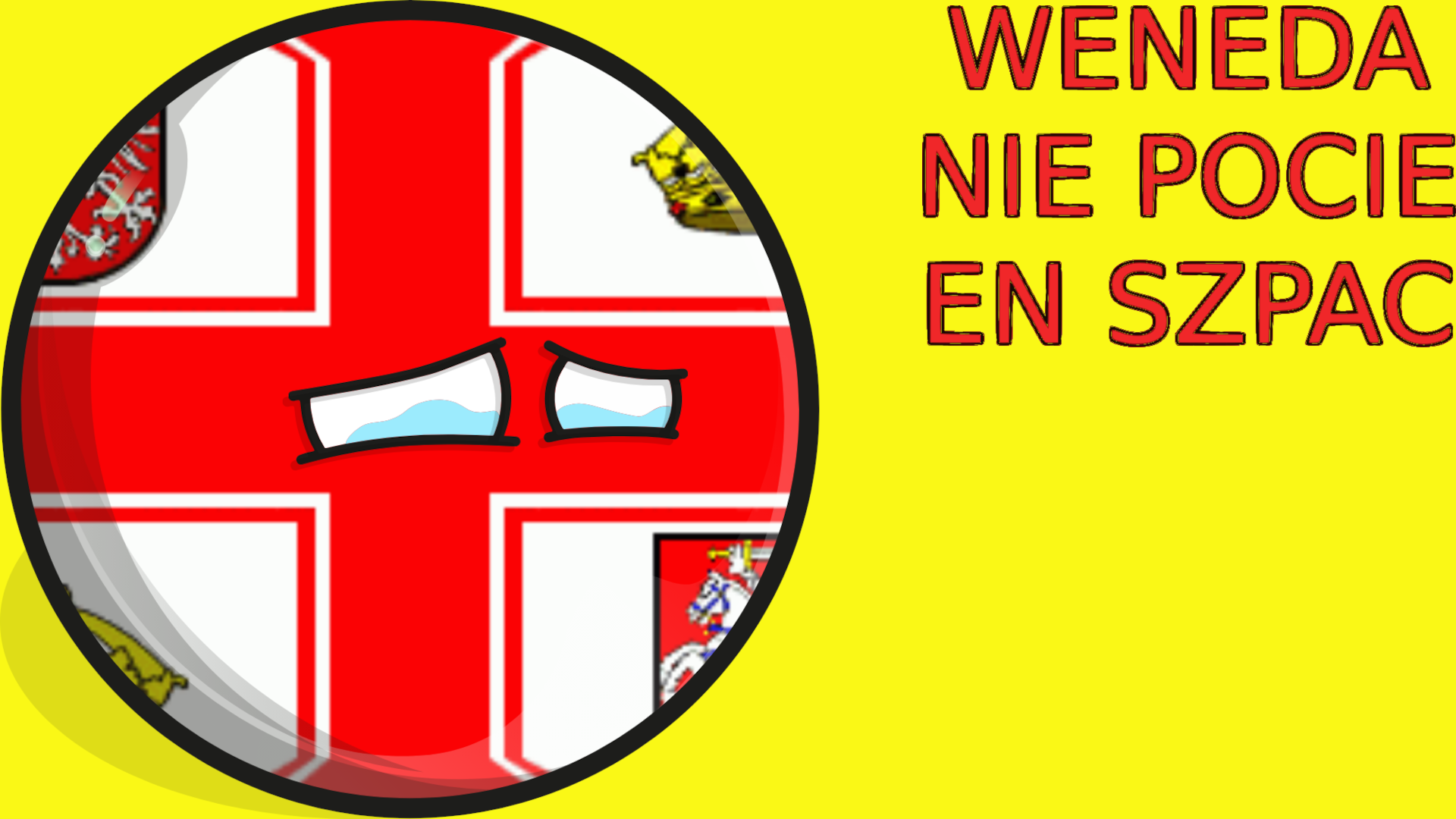
Wenedyk is a creation of Jan van Steenbergen, who also co-created Interslavic (which will almost inevitably get its own article one day) and hosts the materials for Andrew Smith’s Brithenig. In the universe of Ill Bethisad, the Romans were able to extend their rule to the lands of the Venedi, who are considered to be the ancestors of the Poles, and successfully Romanized them. In the universe’s present day, Wenedyk (or Venedic) is the language of the Republic of the Two Crowns, which is based on the historic Polish-Lithuanian Commonwealth. You can see a version of their flag in the “Two Crowns Ball” above, which is saying, of course, “Veneda cannot into space.”
Like Polish, Wenedyk has no articles, setting it apart from all existing Romance languages. Also, unlike most of the modern Romance languages of our universe, Wenedyk has to some extent preserved the case system of late Vulgar Latin. This is not such a wild idea, as Old French had a two-case system, nominative and oblique, before eventually losing it, and Romanian retains a five-case system. Wenedyk has a three-case system: direct (nominative/accusative), dative, and genitive.
Wenedyk also retains a neuter gender, and unlike in Romanian, it isn’t just masculine in the singular and feminine in the plural; it is derived directly from the Latin neuter. For example, the neuter noun wad means path, and its plural is wada. It appears to be derived from the Latin word vadum, meaning a ford or crossing, the plural of which is vada (pronounced identically to wada). The existence of a neuter gender in Wenedyk is understandable, as Vulgar Latin had a neuter gender early on before losing it. Also, from the standpoint that it’s a Romance language imitating Polish, it makes sense that it would have a three-gender system, just as the Slavic languages do.
Wenedyk is pronounced exactly like Polish, down to the “nasal vowels” and distinctions between hard and soft consonants. Nouns fall into three declensions, plus a set of irregular nouns:
- 1st declension (ending in -a): jekuna, f., “woman,”. Genitive singular jekunie, dative singular jekunie, direct plural jekunie, genitive plural jekunar, dative plural jekuniew.
- 2nd declension (ending in a hard or soft consonant):
- Masculine words for people (direct plural in -i or -y):
- Hard stems: moszkieł, m., “man.” Genitive singular moszkłu, dative singular moszkli, direct plural moszkli, genitive plural moszkłór, dative plural moszklew.
- Soft stems: poterz, m., “father.” Genitive singular potrze, dative singular potrzy, direct plural potrzy, genitive plural potrzór, dative plural potrzew.
- Masculine words for animals and objects (direct plural in -ie):
- Hard stems: dom, m., “house.” Genitive singular domu, dative singular domi, direct plural domie, genitive plural domór, dative plural domiew.
- Soft stems: jań, m., “lamb.” Genitive singular janie, dative singular jani, direct plural janie, genitive plural janiór, dative plural janiew.
- Neuter nouns (direct plural in -a):
- Hard stems: wad, n., “path.” Genitive singular wadu, dative singular wadzi, direct plural wada, genitive plural wadór, dative plural wadziew.
- Soft stems: mużej, n., “museum.” Genitive singular mużeje, dative singular mużei, direct plural mużeja, genitive plural mużejór, dative plural mużejew.
- Words ending in –mię: argumię, n., “argument.” Genitive singular argumiętu, dative singular argumięci, direct plural argumięta, genitive plural argumiętór, dative plural argumiętew.
- Words ending in -o: foto, n., “photograph.” Genitive singular fotu, dative singular foci, direct plural fota, genitive plural fotór, dative plural fotew.
- Words ending in -um: album, n., “album.” Genitive singular albu, dative singular albi, direct plural alba, genitive plural albór, dative plural albew.
- Masculine words for people (direct plural in -i or -y):
- 3rd declension:
- Feminine words (direct plural in -ie or -e):
- Hard stems: noc, f., “night.” Genitive singular noce, dative singular nocy, direct plural noce, genitive plural nocy, dative plural nocew.
- Soft stems: pęć, f., “bridge.” Genitive singular pęcie, dative singular pęci, direct plural pęcie, genitive plural pęci, dative plural pęciew.
- Neuter words (direct plural in -a):
- Consonant stems: kród, n. “heart.” Genitive singular krodzie, dative singular krodzi, direct plural krodza, genitive plural krodzy, dative plural krodziew.
- Words ending in –mię: numię, n., “name.” Genitive singular numnię, dative singular numni, direct plural numna, genitive plural numien, dative plural numniew.
- Words ending in -u: ciępu, n., “time.” Genitive singular cięprze, dative singular cięprzy, direct plural ciępra, genitive plural ciępr, dative plural cięprzew.
- Words ending in vocalic -r: fołgr, n., “lightning.” Genitive singular fołgrze, dative singular fołgrzy, direct plural fołgra, genitive plural fołgr, dative plural fołgrzew.
- Feminine words (direct plural in -ie or -e):
- Various irregular nouns, all declined differently: one example is dzej, “day.” Genitive singular dzei, dative singular dzei, direct plural dzeje, genitive plural dzejór, dative plural dzejew.
Verbs fall into an eight-class paradigm, distinguished by both infinitive and perfect form, with certain endings for certain classes causing palatalization of the final stem consonant (marked with a ‘):
- Class 1 (from Latin -are, but not -iare): infinitive in -ar, perfect in -‘e. Example: jemar (to love), from amāre.
- Class 2 (from Latin -ēre and -iare): infinitive in -‘ar, perfect in -ji with depalatalization. Examples: dzielar (to destroy), from dēlēre, and kruczar (to cross), from cruciāre.
- Class 3 (from Latin -ēre): infinitive in -‘ar, perfect in -y. Example: dolar (to hurt, ache), from dolēre.
- Class 4 (from Latin -ēre): infinitive in -‘ar, perfect in -szy. Example: widziar (to see), from vidēre
- Class 5 (from Latin -īre): infinitive in -‘er, perfect in -ji. Example: udzier (to hear), from audīre.
- Class 6 (from Latin -īre): infinitive in -‘er, perfect in -y. Example: oprzer (to open), probably from aperīre.
- Class 7 (from Latin -ere): infinitive in -‘er, perfect in -szy. Example: więdzier (to sell), from vendere.
- Class 8 (from Latin -scere): infinitive in -szczer, perfect in -ski. Example: krzeszczer (to grow), from crēscere.
Adjectives have lost the distinction between declensions and now only distinguish betwen hard and soft stems. The masculine plural is used only for male persons, while all other masculine plurals and neuter plurals use the “other” declension.
- Hard stems: bony, “good” (masculine and neuter singular direct). Masculine/neuter singular genitive bonu, masculine/neuter dative singular boni, masculine plural direct boni, genitive bonór, dative boniew. Feminine singular direct bona, genitive/dative boniej, plural direct bonie, genitive bonar, dative boniew. Other plural direct bonie, genitive bonór, dative boniew.
- Soft stems: froci, “strong” (masculine and neuter singular direct). Masculine/neuter singular genitive frociu, masculine/neuter dative singular froci, masculine plural direct froci, genitive frociór, dative frociew. Feminine singular direct frocia, genitive/dative frociej, plural direct frocie, genitive frociar, dative frociew. Other plural direct frocie, genitive frociór, dative frociew.
There is also, as in many Slavic languages, including Polish, a shortened form of the adjectives used in predicates and nominalized adjectives. For example, grędzi dom means “a big house” or “the big house,” while Ił dom je grądź means “That house is big.” Also, Wenedyk is the shortened form of wenedki, meaning “pertaining to Veneda.”
The first part of Article 1 of the Universal Declaration of Human Rights in Wenedyk reads, “Tuci ludzie noszczę sie liwrzy i jekwali z rześpiece świej dzińtacie i swór drzecór.” Let’s break this down:
- tuci: “all,” from Latin tōtī, masculine plural of totus, meaning “whole,” or “all” in its modern descendants.
- ludzie: “people,” from Polish ludzie, meaning “people.”
- noszczę sie: “are born,” from Latin nāscere, meaning “to be born,” and se, meaning “oneself.” In Wenedyk, it becomes a reflexive verb.
- liwrzy: “free,” from Latin līberī, masculine plural of liber, meaning “free.”
- i: “and,” from Latin et, meaning “and,” though it is identical to Polish i.
- jekwali: “equal,” from Latin aequālēs, masculine plural of aequālis, meaning “equal.”
- z: “under,” from Latin sub, meaning “under.”
- rześpiece: from Latin respectus, meaning “a looking back” or “respect.”
- z rześpiece: an idiom, “from the point of view of.”
- świej, swór: “of their,” from Latin suae and suōrum, meaning “one’s own,” or “his/her/its/their” in its modern descendants.
- dzińtacie: “of dignity,” from Latin dignitatis, meaning “of dignity”
- drzecór: “of rights,” from Latin dīrēctōrum, which takes on the meaning of “of rights” or “of entitlements” in Vulgar Latin.
tuci ludzie no-szczę sie liwrz-y i jekwal-i z rześpiec-e św-iej dzińtac-ie i sw-ór drzec-ór
ALL people born-3PL.PRSNT PRO.REFL free-PL AND equal-PL under respect-GEN PRO.3POS-F.SG.GEN dignity-GEN AND PRO.3POS-M.PL.GEN right-GEN.PL
While we’re at it, let’s take a look at the most famous part of the “Ring Poem” from Lord of the Rings in Wenedyk:
Wyn jądeł prokód rzeżer łosz tutór,
Wyn jądeł prokód łosz jęwnier,
Wyn jądeł prokód kolżer łosz tutór,
I o cembartać olegar.
- wyn: “one,” from Latin ūnus, “one.”
- jądeł: “ring,” from Latin annellus, an attested alternate form of ānellus, “ring.”
- prokód: “in order to,” from pro (for) + kód (that), from Latin prō, “for,” and the Vulgar Latin meaning of quod, “that (complement).”
- rzeżer: “to rule,” from Latin regere (to rule).
- łosz: “them,” from Latin illos (them).
- tutór: “of all,” from Latin tōtōrum (of all).
- jęwnier: “to find,” probably from Latin invenīre (to find).
- kolżer: “to collect,” from Latin colligere (to gather, assemble, bring together).
- i: again, this is from Latin et.
- o: “to,” possibly from Latin ob (toward).
- cembartać: “darkness,” probably from a fictional Vulgar Latin tenebritas (darkness).
- olegar: “to bind,” probably from Latin obligare (to bind, usually non-literally).
wyn jądeł pro-kód rzeż-er ł-osz tut-ór
one ring for-COMP rule-INF PRO.3-ACC.PL all-GEN.PL
wyn jądeł prokód ł-osz jęwn-ier
one ring for-COMP PRO.3-ACC.PL find-INF
wyn jądeł prokód kolż-er ł-osz tut-ór
one ring for-COMP collect-INF PRO.3-ACC.PL ALL-GEN.PL
i o cembartać oleg-ar
AND PREP.DIR darkness bind-INF
The level of detail that went into making Wenedyk is really incredible; it’s a lot of fun to delve into and read about, just as Brithenig is for similar reasons. If you haven’t dove down the rabbit hole of Ill Bethisad yet, I highly recommend checking out Wenedyk, Brithenig, and Jovian, my three favorite that I’ve encountered so far. But there’s so much else out there that I haven’t even learned about yet. It was a really cool collaborative project between conlangers, the kind I’d like to see more of today.
So far, I’ve kept the “Conlang of the Week” thing going for two weeks. Let’s see what next week brings. I hope you enjoy reading about these conlangs as much as I enjoy researching and writing about them.